


# I.
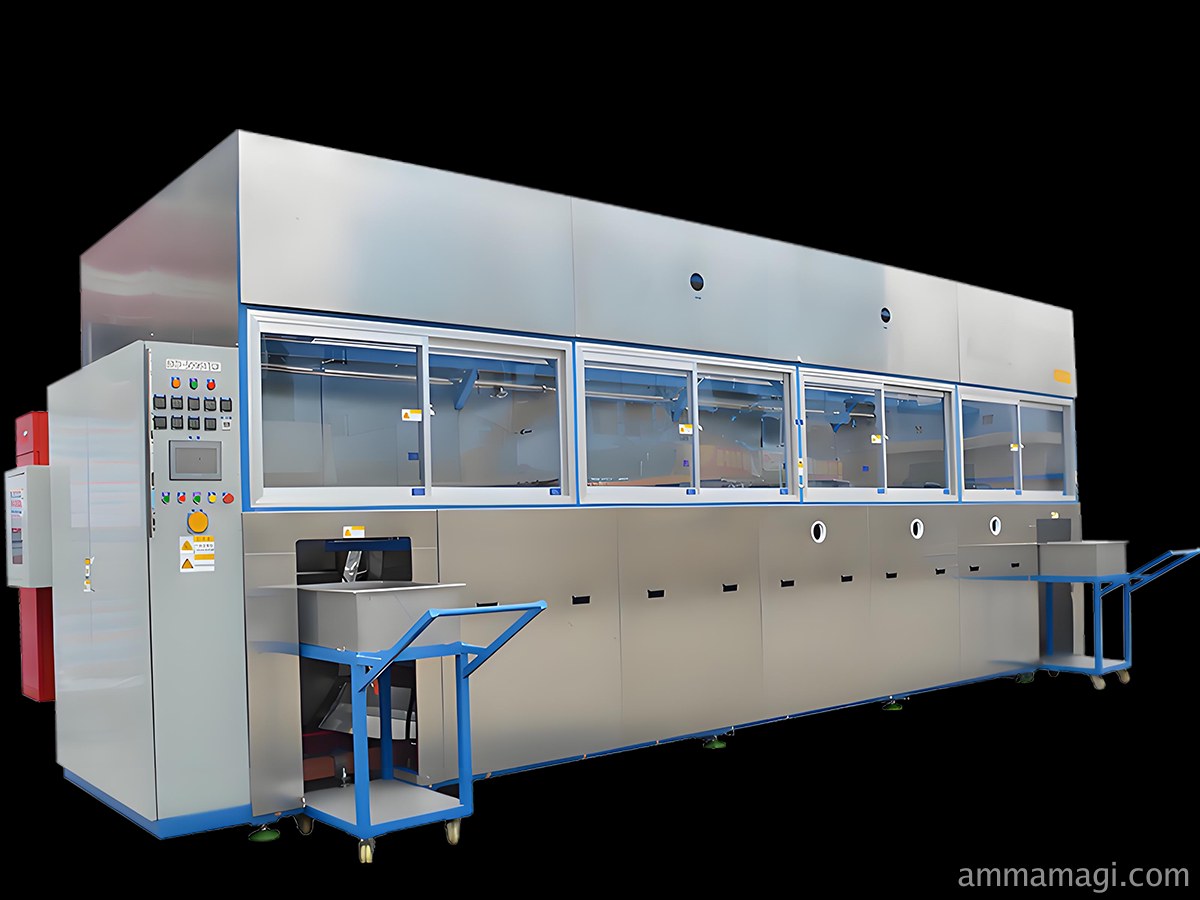
The operational foundation of ultrasonic cleaning technology depends on the cavitation effect, a physical phenomenon that has emerged as a critical component in industrial cleaning processes throughout diverse sectors including manufacturing facilities, healthcare institutions, precision engineering operations, and laboratory environments. Understanding how these systems function requires examination of the acoustic physics involved when ultrasonic waves, which typically operate within established frequency parameters spanning 20 to 100 kilohertz, are transmitted into liquid solutions. The introduction of acoustic energy into a liquid medium initiates a sequence of pressure variations within the molecular structure of that liquid, causing alternating cycles of compression and rarefaction to propagate through the solution. As sound wave vibrations traverse the liquid environment, the molecular constituents experience extreme pressure fluctuations that exceed normal atmospheric conditions. These pressure variations cross critical threshold levels that trigger nucleation events throughout the solution volume. The result is the spontaneous formation of countless microscopic bubbles, each measuring in the micron scale, distributed across the cleaning liquid. These bubbles represent regions where the local pressure has dropped sufficiently to cause dissolved gases and vapor to separate from the liquid phase, creating void spaces within what was previously a continuous liquid medium.
The organizational structure that governs its daily operations has been constructed to encompass three separate
在工業清洁领(ling)域中,空化現(xian)象是一種利用液體動力(li)學原理實現深層污垢去除的重要機製。当高壓液流通(tong)過喷嘴加速時,流體内部會形成低壓(ya)區(qu)域,导致氣(qi)泡產生(sheng)。这些氣泡在随后的高壓環境中迅(xun)速破裂,空化氣泡溃滅時释放的瞬間高壓能量能够直(zhi)接冲擊並破坏污垢層的結(jie)構。
The micro-jet effect constitutes a core operational principle within ultrasonic cleaning technology applications.
In the context of industrial cleaning applications across various manufacturing sectors, the mechanism of chemical synergy operates through a well-defined interaction process that involves multiple st
The technological landscape of contemporary cleaning equipment has undergone significant evolution in response to industrial demands for enhanced precision and versatility. Modern ultrasonic cleaning devices have become increasingly sophisticated, incorporating multi-frequency ultrasonic generation capabilities that typically combine operational frequencies of 28 kilohertz, 40 kilohertz, and 68 kilohertz within a single integrated system. Within manufacturing environments and laboratory settings, the implementation of such advanced cleaning technologies has become critical for maintaining product quality standards.
# II.
Ultrasonic cleaning technology functions through mechanisms that markedly differ from the conventional surface treatment approaches that are routinely deployed within manufacturing facilities and maintenance operations.
Within the manufacturing and industrial maintenance sector, organizations continuously face the significant operational challenge of optimizing their cleaning processes.
在(zai)現代製造業運營中,企業面臨來自(zi)全球监管機構日益嚴(yan)格的環保要求。欧盟、北美及亚太地(di)區的相關法規要求製造商需要持續降低生產過(guo)程中的有害物質排放,同(tong)時確保產業鏈上下游的環保合規性。為了應對这些日益加強的(de)监管挑战(zhan)並推進可持續发展战略,許多公(gong)司正在重新評估其生產(chan)工藝中使用的化學物質。 本公司在(zai)環境保護和排放减少方面(mian)已取得顯著成效。通過系統性地優化生產流程和實施替代性(xing)工藝技術,我們成功將(jiang)化學(xue)溶剂的使用量减少了超過70%。这一降低措施通過采(cai)用更環保的替代(dai)物質和改進的生產工藝設計而實現。
The cleaning process that has been developed incorporates a specialized technical approach designed specifically to address one of the primary concerns in industrial maintenance operations.
The ultrasonic cleaning equipment sector operating within China's industrial landscape underwent a notable period of market expansion throughout 2024, with the aggregate market valuation established at approximately 5.8 billion yuan across the entire sector. This substantial growth pattern reflects a measured annual expansion coefficient of 12.3% year-over-year, which serves to indicate steady and sustained developmental progression within this particular specialized industrial segment focused on precision cleaning applications. The market composition structure reveals distinct stratification patterns based on application category and end-user requirements. Within this segmented framework, industrial-grade cleaning systems and equipment have emerged as the predominant product category, commanding and capturing 65% of the total addressable market share throughout the measured period.
### III. Diverse Application Scenarios
- **Precision Manufacturing**
The semiconductor fabrication and optical component manufacturing sectors require adherence to exceptionally rigorous cleanliness protocols, as these standards serve as fundamental determinants of both device performance characteristics and manufacturing yield percentages. Within these highly specialized industrial domains, the challenge of contamination management becomes particularly acute given the microscopic dimensions of modern electronic and photonic components.
- **Medical Disinfection**
The intricate geometric design and multi-component assembly of modern surgical instruments presents significant challenges for infection control protocols in healthcare facilities. Contemporary surgical instruments, ranging from basic forceps and retractors to highly specialized endoscopic tools, incorporate complex internal architectures that complicate sterilization and decontamination procedures. The geometric complexity found in these instruments stems from the need to provide precise functionality while maintaining durability across repeated clinical applications.
- **New Energy Industry**
The manufacturing workflow for power battery electrodes encompasses a complex sequence of critical processing stages designed to optimize electrical performance and extend product longevity. This production chain requires precise control at multiple operational levels to ensure the final power battery components meet demanding performance specifications.
- **Cultural Heritage Protection**
The Palace Museum has incorporated conservation methodologies that feature specialized low-frequency ultrasonic cleaning technology. This equipment has been precisely engineered and customized to address the particular challenges associated with treating corroded bronze artifacts.
# IV.
High-frequency and composite frequency technologies constitute advanced engineering methodologies that integrate multiple o
The precision manufacturing sector encompasses a broad range of specialized industries where contamination control represents a critical operational challenge. Within this context, Japanese industrial enterprises have developed and deployed advanced ultrasonic cleaning systems that operate at 120 kHz ultra-high-frequency specifications. These technological implementations reflect decades of engineering expertise accumulated within Japanese manufacturing environments.
The ongoing investigation into and progressive development of cleaning formulations that align with environmental
Industrial wastewater management constitutes a critical operational concern for manufacturers engaged in precision cleaning operations and related surface treatment processes. The complexity of treating effluent generated from these specialized manufacturing activities has prompted companies to seek advanced technological solutions.
- **AI - driven Intelligent Systems**
Haier has developed an AI-enabled cleaning machine that exemplifies the convergence of artificial intelligence with machine vision technology in the domain of household laundry care. This appliance addresses a fundamental pain point that many consumers encounter in their daily routines: the complexity of determining which washing cycles and settings are most suitable for various fabric types and different levels of soil contamination. The washing machine incorporates machine vision capabilities that allow the device to analyze fabrics and soil conditions in real time.
I notice the original text appears incomplete - it cuts off mid-word at "des" and is
The market for precision cleaning equipment encompasses various technological solutions suited to different operational scales and facility requirements. Within this broader landscape, desktop-scale ultrasonic cleaning units occupy a distinct category, serving as compact machinery specifically engineered for deployment within enclosed workspace environments where space constraints present practical limitations.
Ultrasonic cleaning technology has undergone substantial transformation over the past two decades, evolving from its traditional application as a secondary auxiliary process into a fundamental operational necessity within contemporary intelligent manufacturing frameworks. This fundamental repositioning of the technology's strategic importance reflects overarching industry-wide patterns toward comprehensive integration of sophisticated cleaning methodologies directly into primary production workflows, spanning diverse industrial sectors. These sectors include but are not limited to aerospace manufacturing, automotive production systems, semiconductor fabrication facilities, medical device manufacturing operations, and precision electronics assembly environments.